By Wesley M. Porter
As we move through August and into September, as is typical we have observed adverse weather conditions across the state. In some places, we have been receiving rainfall on an as needed basis to allow us to apply minimal irrigation, however, there are other parts of the state that we cannot keep up with the water demand of the crop. It seems like we will have some hard rainfall for a few days then go a week to weeks without significant rainfall. This is making it tough to plan, complete sprays and field work, and stay on top of irrigation management. While the price of cotton has increased recently, economics are still tough. One input cost, especially at the end of the production season that can make a significant difference in profitability is irrigation. Currently, we are at about $9/ac-in for electrical pumping costs and around $22/ac-in for diesel pumping costs. Thus, especially if you are pumping with diesel, the decision on when and how much to irrigate or not to irrigate should be made with confidence.
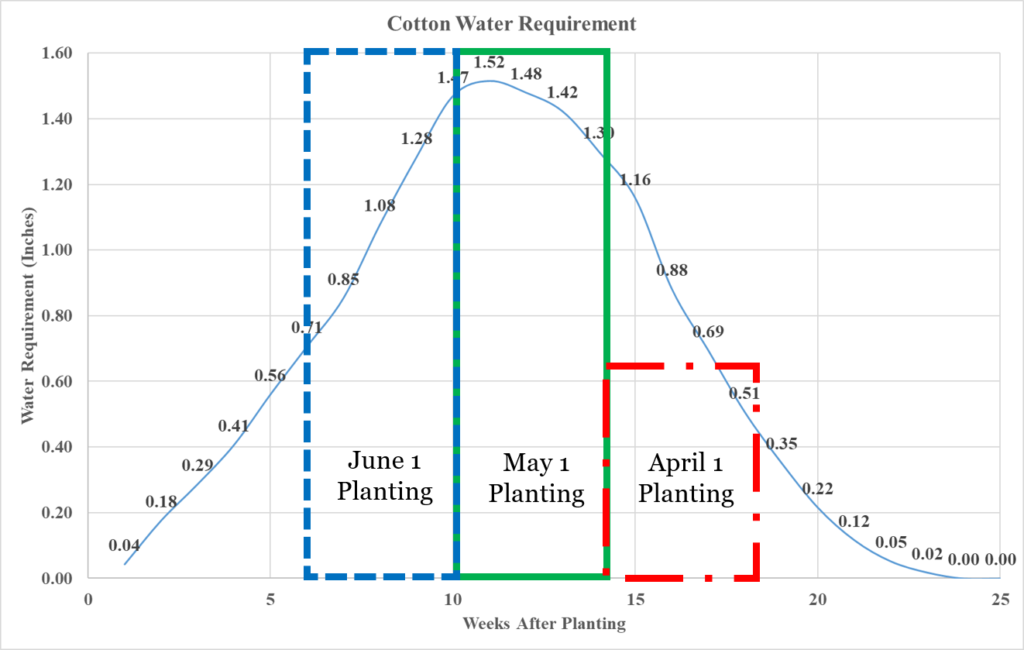
Based on the current date, and estimated planting dates, we are ranging from irrigation termination to just moving into peak water requirements across the state and spread of planting dates. Earlier planted cotton is most likely moving into the recommended irrigation termination period. Where cotton planted during May and June falls somewhere between moving into and out of the peak water requirement period. The 8-week bloom period on cotton aligns with its peak water requirement, thus, when scouting your field and looking at planting date, estimate which week of bloom you are in and ensure that you are matching irrigation to the requirements. Also, keep in mind that the UGA Checkbook was developed based on historical average ET data, and that recently we have been much hotter than average, so actual water requirements are most likely higher than reflected in the graph below.
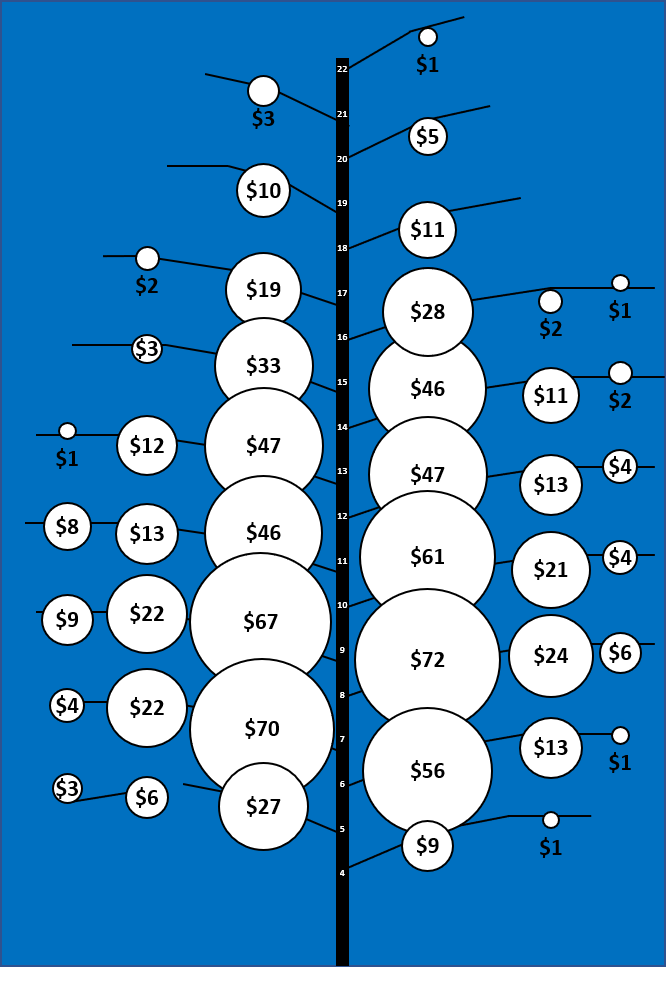
As the crop moves through the weeks of bloom and begins to approach the 8th week of bloom, it is time to start monitoring the field for maturity and specifically scouting for cutout. The table below corresponds to the image of the cotton plant (Both developed by Whitaker et al. 2019) and represents the value of seed cotton and fiber by location on the cotton plant. The short conclusion to this is that the majority of value from the cotton plant comes from the first position bolls developed on nodes 10 and below. Value by location is important when discussing irrigation termination and defoliation. In this case we are going to focus specifically on irrigation termination. As most who work with cotton know, the first bolls that we will rot, or lose is typically the bottom bolls. Thus, we want to manage our irrigation so that we do not make increase the likelihood of disease causing boll, yield, and profit loss.
| Fruiting Location | Percentage Value of Fiber |
| 1st Position Bolls | 72% |
| 2nd Position Bolls | 18% |
| 3rd Position Bolls | 5% |
| Vegetative Branches | 5% |
| Node Location | Percentage Value of Fiber |
| Nodes ≤10 | 60% |
| Nodes 11-15 | 31% |
| Nodes ≥ 16 | 9% |
Cotton Irrigation Termination
Multiple studies have focused on determining the appropriate timing for irrigation termination and the conclusions from those studies agree that terminating at cutout provides no difference in yield from terminating later in the season. These studies have shown differences from $3/ac up to $85/ac of additional input costs from unnecessary irrigation later in the season. Thus, based on these studies, irrigation termination from both the yield and profit standpoint have shown that cutout is the optimum timing. It should be stated and noted that all of these studies had adequate soil moisture at the time of termination. Thus, ensure that you are managing your irrigation adequately up to this point and make a final decision as you approach cutout based on weather predictions, irrigation, and estimated soil moisture on when you should terminate irrigation.
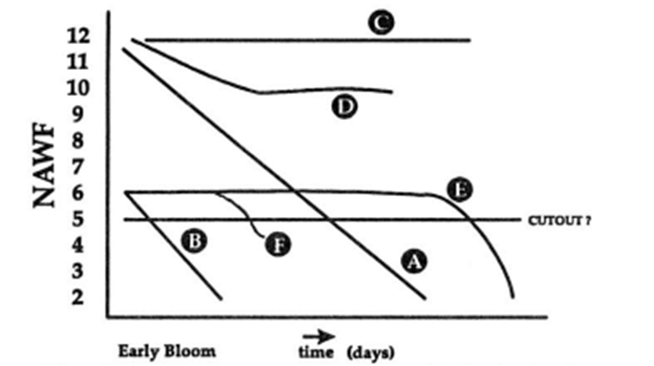
When looking at determining cutout, that can come at different stages based on season, variety, and growth characteristics. An article shared to me by Camp Hand from Cotton Physiology Today does a very good job of explaining how to document time to cutout in the crop. Typically, we use a rule of thumb of 3 nodes above white flower (NAWF), but as stated earlier and in the linked article there are factors that influence maturity such as early season stress like we observed during June when it became hot and dry again. The figure below shows multiple cases of cotton maturity moving into cutout.
We have had an adverse season, with periods of drought, extreme rainfall, followed by more drought. In most cases we have observed the subsoil moisture being depleted and not replenished. This puts us in a tough place; it is very difficult if not near impossible to replenish soil moisture levels deeper than 12 inches with irrigation in most cases. Mature cotton plants extract moisture fairly evenly across their rooting profile, but since we are only able to replenish moisture in the top portion of the soil profile with irrigation. Thus, as you progress through bloom and approach cutout, it is important to work to refill the profile as much as possible. This can be accomplished via similar methods that were discussed in the post https://precisionagirrigation.extension.uga.edu/2026/08/extreme-heat-and-irrigation-dont-let-your-crop-get-behind/. I would encourage you to maximize irrigation efficiency, perform back-to-back irrigation events as necessary to refill the profile, and monitor responses.
From the 2026 UGA Cotton Production Guide Page 152: A final irrigation event is often applied when the crop begins to open. Commonly, NO additional irrigation is applied once the crop reaches 10% open boll to minimize problems with boll rot, hard lock, light spot, and other fiber quality issues. Additionally, a multi-year study which is published, has shown no effects on yield when irrigation was terminated during cutout (NAWF = 3) versus 10% open boll.
Thus, the current irrigation termination recommendation is at 10% open boll, but I would encourage you to monitor your field, and consider terminating irrigation around cutout, and if you are not comfortable with that yet, at a minimum do not apply irrigation after you have documented open bolls in your field. You should manage soil moisture up to cutout at an adequate level and ensure you have sufficient soil moisture before making the final irrigation termination decision.
If you have further questions about end of season irrigation and irrigation termination on cotton, reach out to your local UGA Extension County Agent. This is a critical period that can help you gain/maintain yield and profit that you developed during the production season.