By Lauren Lazaro, UGA Extension Precision Ag Specialist
There are two main types of liquid fertilizer applicators: 1. Continuous and 2. Non-continuous or pulsed applicators. These application methods should be calibrated with water before each application to achieve the desired application rate (GPA).
Continuous Liquid Fertilizer Applicators
When liquid fertilizers are used as the carrier, applicators should be aware that flow rates may differ from those measured with water—particularly at higher application rates—due to the greater density of fertilizer solutions. As a result, a correction factor is recommended when water is used to calibrate equipment intended for liquid fertilizer application. In most pesticide applications, this adjustment is not necessary because water is the primary carrier, and pesticide concentrations are typically too low to alter solution density. However, if pesticides are applied using liquid fertilizers or other non-water carriers, a correction factor should be used to help ensure accurate and consistent application rates.
The table below provides adjustment factors for some continuous liquid fertilizer solutions, including a few commonly used nitrogen sources.
| Product | Density (lb/gal) | Specific Gravity | Adjustment Factor |
|---|---|---|---|
| 28-0-0 | 10.65 | 1.28 | 1.13 |
| 30-0-0 | 10.80 | 1.30 | 1.14 |
| 32-0-0 | 11.06 | 1.33 | 1.15 |
| 7-21-7 | 11.20 | 1.34 | 1.16 |
| 10-34-0 | 11.40 | 1.37 | 1.17 |
| 12-0-0-26 | 11.50 | 1.38 | 1.17 |
| 11-37-0 | 11.60 | 1.39 | 1.18 |
How to use an adjustment factor: For example, a side-dress applicator needs to be calibrated to apply 28% UAN fertilizer at an application rate of 20 GPA. If calibrating using water only, at what application rate (GPA) should you calibrate the sprayer?
Using the Table above, 28% UAN (28-0-0) has a density of 10.65 pounds per gallon and an adjustment factor of 1.13. Multiplying the label rate by the adjustment factor will give the water-only rate used when calibrating our sprayer:
From here, a nozzle size should be selected that will supply 22.6 GPA of water at the desired pressure, speed, and nozzle spacing.
With the proper nozzles installed, perform a sprayer calibration using the 1/128th of an acre sprayer calibration methodology to ensure everything is operating properly.
To do this, the machine needs to be set up to spray at the desired operating settings while stationary. The machine should be operated at full engine speed, pressure set to field operating level, and all the boom sections open and spraying. Do this for each nozzle on the machine. It is often easier to have a second person helping so they can operate the stopwatch and record the volumes from each nozzle while you hold the container at each nozzle. Once complete, review the values and check for any that are deviating too far from your desired flow rate.
Non-Continuous or Pulsed Liquid Fertilizer Applicators
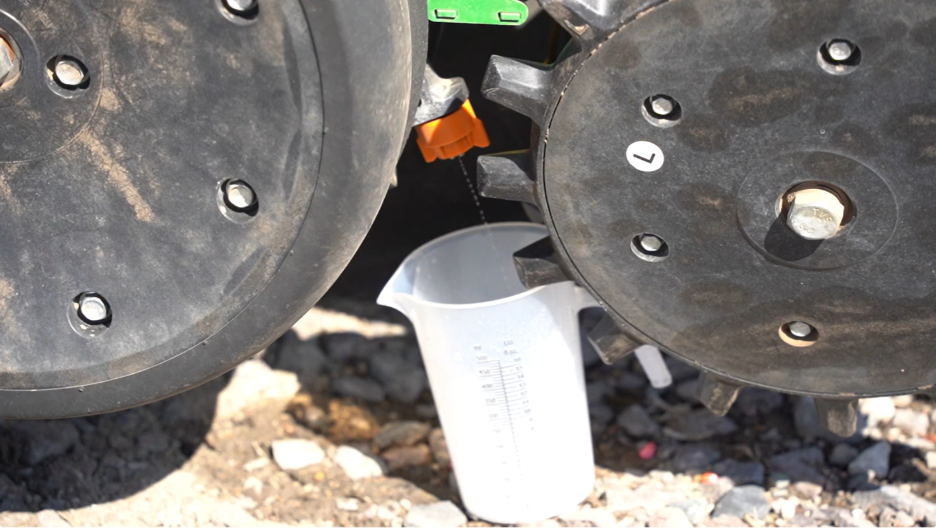
Unlike continuous liquid systems, non-continuous or pulsed fertilizer applicators, such as the John Deere ExactShotTM, precisely doses fertilizer at each seed. To ensure row-to-row accuracy, a catch test needs to be completed by simulating planting conditions and capturing multiple doses. The measured volume is compared to the system’s expected output, and adjustments are made in the display. Multiple rows should be tested for consistent and accurate calibration across the planter.
Example: Place a measuring cup under row 1 to catch the water. In the cab, you will move through the Menu by going to Calibrations and Procedures. Then, under Procedures, choose the Liquid Runoff Test followed by Dosing Rate Verification. Input your seeding rate (seeds/acre) and planting speed (mph). Initiate the test for row 1 by hitting the Start button. Once test is finished check the caught output and compare that value to the reported value in the cab. You can update the actual value.
For both options, nozzles that are producing significantly less flow than they may be clogged, especially if the system was not fully flushed after the last application. Check and clean these nozzles then retest them to get a new flow rate. A clogged nozzle can impact the flow out of surrounding nozzles as well, so it may be beneficial to check other nearby nozzles again. Any nozzle deviating from the desired flow by more than 10% should be replaced. If there are multiple nozzles deviating 10% or more, consider replacing the entire set of nozzles. In some cases, the issue may be with the orifice, thus it is critical to check every row to ensure all rows are applying within 10% of the target rate.
We are currently working on the development of comprehensive Extension materials to support this topic in more detail. We will update this post with the link to that document when it is completed and online.