By David Hall, Jason Mallard, Phillip Edwards, Savannah Beasley, Wesley Porter, Sarah Beth Thompson
A few weeks ago, we had our agronomists update on planting considerations for this season’s unseasonal hot and dry conditions. Most of these two articles are included in the May Peanut Pointers and Cotton Team Newsletter, but I have decided to post them here too, to provide them in another source for anyone who may need them.
Now we are moving into peak peanut and cotton planting season and as of the April 27, 2026 USDA Crop Progress Report (https://esmis.nal.usda.gov/publication/crop-progress) approximately 6% already being planted in Georgia so far. Even though we received over 2 inches of rainfall over the past weekend, we are still in a drought. We have replenished soil moisture within the management profile for now. We do have more rainfall predicted in the near future, and hopefully, that will come through. However, with the drought conditions, it is important to make and prepare a solid irrigation management plan. While a wetter May is predicted and a little bit of rain is great, but it hasn’t solved our drought problems, thus, we need to anticipate a potential for these drier conditions to continue. We were able to get a much-needed rain this weekend, which will hopefully help us as we continue to move through planting season.
Peanut
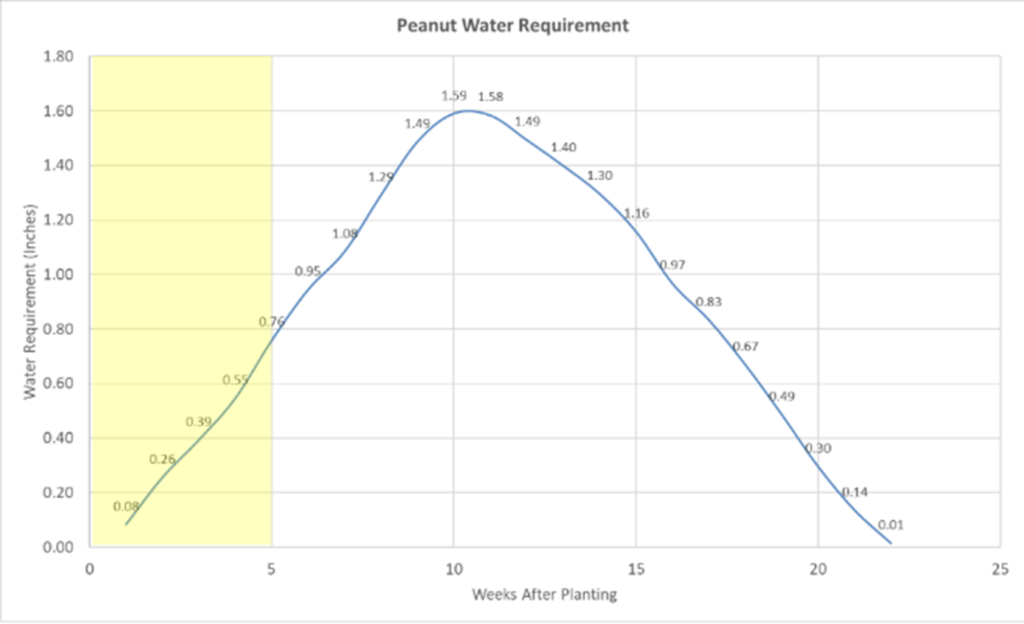
Without any significant rainfall events, irrigation prior to planting and shortly after planting will most likely be needed to help with germination, emergence, and activate herbicides. Keeping both irrigation events in mind, you do not want to solely irrigate after planting because the cooler water can tend to shock the seed, especially if it has been very hot and dry prior to planting. There are several irrigation scheduling techniques available for adoption on the farm which range from soil moisture sensors to computer models with the simplest being the UGA Checkbook Method, shown in the graph below. The water requirements for the first 40 days after planting are highlighted in the yellow box. It is critical to irrigate accordingly during this growth stage to not start the season behind moving into peak water use during the middle of the season.
When using soil moisture sensors, it is important to use the most representative area of the field and consider the crop planting date. Crop age and estimated root development is important when taking a weighted average of sensor depths. A basic weighting of these depths for peanuts is as follows below with the shallow sensor being an 8-inch, middle being 16 inches, and the deepest being 24 inches. While your sensors may not match these exactly you should be able to use this as an example to match your specific field conditions. Soil moisture sensors provide reliable accuracy for monitoring the available soil moisture within the root zone.
Without any significant rainfall events, irrigation prior to planting and shortly after planting will most likely be needed to help with germination, emergence, and activate herbicides. Keeping both irrigation events in mind, you do not want to solely irrigate after planting because the cooler water can tend to shock the seed, especially if it has been very hot and dry prior to planting. There are several irrigation scheduling techniques available for adoption on the farm which range from soil moisture sensors to computer models with the simplest being the UGA Checkbook Method, shown in the graph below. The water requirements for the first 40 days after planting are highlighted in the yellow box. It is critical to irrigate accordingly during this growth stage to not start the season behind moving into peak water use during the middle of the season.
When using soil moisture sensors, it is important to use the most representative area of the field and consider the crop planting date. Crop age and estimated root development is important when taking a weighted average of sensor depths. A basic weighting of these depths for peanuts is as follows below with the shallow sensor being an 8-inch, middle being 16 inches, and the deepest being 24 inches. While your sensors may not match these exactly you should be able to use this as an example to match you specific field conditions. Soil moisture sensors provide reliable accuracy for monitoring the available soil moisture within the root zone.
D1 = shallow sensor D2 = middle sensor D3 = deepest sensor
• Early-Season: 80% * D1, 20% * D2, 0% * D3
• Early-Mid Season: 60% * D1, 30% * D2, 10% * D3
• Mid-Season: 50% * D1, 25% * D2, 25% * D3
• Late-Season: 40% * D1, 30% * D2, 30% * D3
Cotton
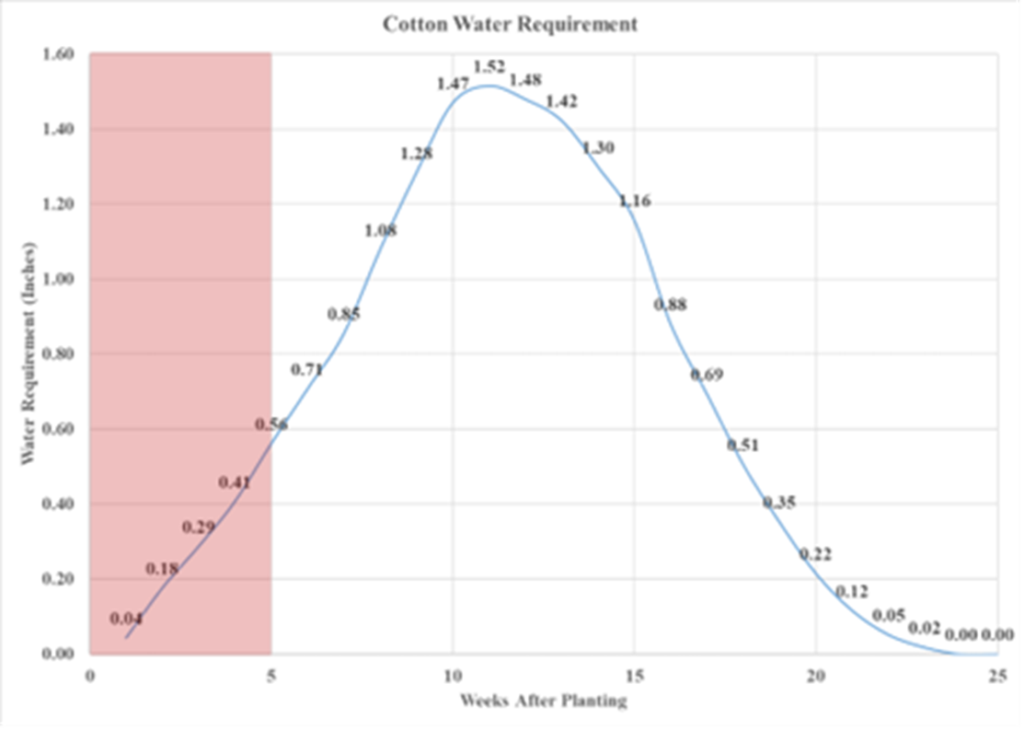
With cotton planting occurring in tandem with peanuts, the weather conditions may vary as we continue to progress through May. If we continue to remain in these severe drought conditions, pre-planting irrigation at a rate of 0.5 to 0.75 inches can be beneficial. Similar to peanuts, irrigation after planting in cotton is needed for emergence, herbicide activation, and pre-emerge chemicals for maximum benefits. As you move further through the season, an irrigation scheduling tool and boots on the ground assessments are much needed to see the amount of moisture within the soil profile. The UGA checkbook method for cotton is below, which shows the total water needed including irrigation plus rainfall, and the red box highlights the early season water requirements for the first five weeks. There are other resources available for irrigation scheduling such as soil moisture sensors or the SI CropFit app.
If using soil moisture sensors, it is important to not only look at the visible aspects of the crop but to not forget what is below the surface. Below are the UGA Extension suggestions for how to “weight” the different depths for cotton development throughout the season. Similar to my comments about peanut, these are just examples, but you should apply your exact sensor depths, field information, and crop growth parameters to a weighting scheme. Keep in mind that if these sensors are installed into a non-representative area in the field, they can be adjusted or un-installed and reinstalled during the season into a different more representative area of the field for better or more accurate readings to base irrigation scheduling decisions on. Soil moisture sensors have been proven to be one of the most profitable methods for scheduling irrigation and providing real-time data when utilized correctly.
D1 = shallow sensor D2 = middle sensor D3 = deepest sensor
• Early-Season: 80% * D1, 20% * D2, 0% * D3
• Early-Mid Season: 60% * D1, 30% * D2, 10% * D3
• Mid-Season: 50% * D1, 25% * D2, 25% * D3
• Late-Season: 40% * D1, 30% * D2, 30% * D3
Going into this season with a solid and scientific irrigation scheduling plan is recommended so you do not run out of water (surface source), over irrigate and waste water, or miss your target application rate. This can help you maximize irrigation allocations, Irrigation Water Use Efficiency, profitability, and most likely yield. If you have questions about irrigation management reach out to your UGA County Extension Agent.