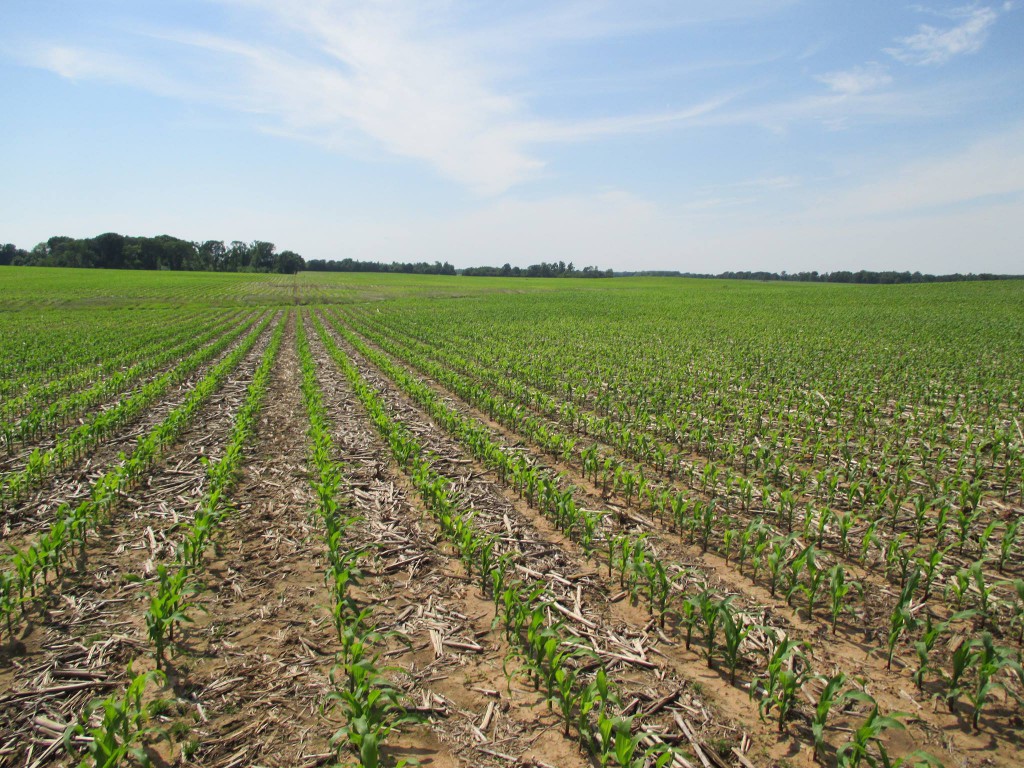
By Ross Greene, Tyler Poythress, Sarah Beth Thompson, Wesley Porter
If you have not already reached irrigation termination on corn, it is almost that time for considering finalizing corn irrigation. The official irrigation termination for corn is black layer. This post will offer a few images on what to look for, how current conditions are affecting the dry-down process, and a current study at SIRP focusing on corn irrigation and nitrogen management.
The Milk Line
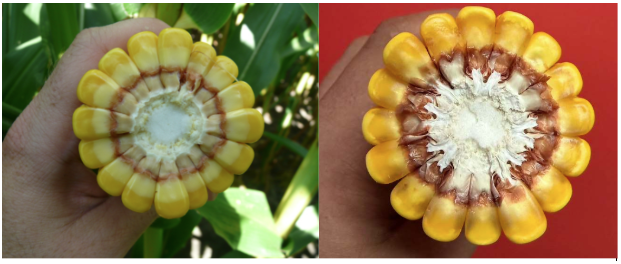
The image on the left displays the milk line at approximately 50%, and on the right the image displays an 85-90% milk line. The process of determining how quickly the corn will dry down is especially difficult given the rapid changes in weather conditions. The weather in South Georgia has recently consisted of many pop-up showers and thunderstorms that have been keeping the humidity level high. Humidity has a major impact on how fast this process occurs, with South Georgia humidity being around 75% or higher.
To put timing into perspective, corn will enter the dent stage (R5) approximately 31-33 days after silking. Usually within a week of the kernels beginning to dent, a white milk line will appear. This line shows the transition of the milky liquid to a solid starch inside the kernel. During this stage, the water demand will decrease; however, until the crop reaches physiological maturity at black layer, grain fill will still occur requiring between 0.24 and 0.27 inches of water per day
Black Layer
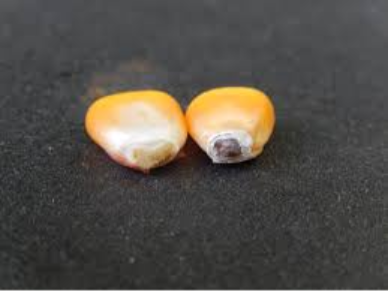
In this picture, the left kernel has not reached black layer, and the kernel on the right has reached black layer. The term black layer refers to the black coloring on the tip of a kernel. This coloration shows that the kernel has reached physiological maturity or R6, and after this point, the kernel will dry down to harvestable moisture.
Once you start to see black layer forming you should:
- Pull 6 to 8 ears from representative areas of the entire field (not from the field border explicitly).
- Break the ears in half and examine the milk line on the cross section of the kernels.
- When the milk line has dropped to around 50-75%, current soil moisture and forecast should be evaluated to make a final irrigation termination decision.
- If your field has adequate soil moisture and a rain event is expected, irrigation can be terminated. To prevent yield loss from occurring, an additional irrigation event may be needed is neither of these are true.
Estimated field corn yield and revenue loss at varying irrigation termination intervals
| Milk Line at Irrigation Termination | Estimated Yield Loss | Bushel Loss (220 bu/ac potential) | Revenue Loss ($4.80/bu) |
| At dent stage (0% milk line) | 15-20% | 33-44 bu/ac | $158-211 |
| 25% milk line | 10-15% | 22-33 bu/ac | $105-158 |
| 50% milk line | 5-10% | 11-22 bu/ac | $52-105 |
| 75% milk line | <5% | 0-11 bu/ac | $0-52 |
| Black layer (100% milk line) | 0% | 0 bu/ac | $0 |
Current Irrigation Research
A study looking at different nitrogen rates and irrigation treatments in corn is being conducted at the Stripling Irrigation Research Park near Camilla, GA. Irrigation is scheduled based on soil moisture sensors installed at 8, 16, 24 inches. Taking a closer look at this field’s conditions, the graphs below display the readings from April 10th to July 16th. This field was planted on March 25, 2026, and is currently in the R5 growth stage.
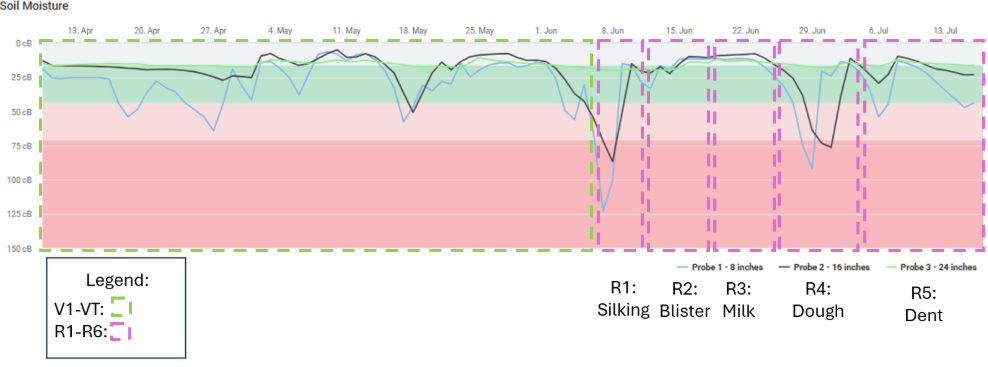
As corn matures, its water requirement per week will increase until R5 or dent. With this irrigation trial being planted in late March, the corn will reach its reproductive stages during the beginning of summer when temperature also begins increasing. As the temperature increases, so does evapotranspiration. The graph shown above has a set of green and purple boxes outlining dates throughout the growing season. During the vegetative stages, the outside temperature was lower, meaning less water loss from evapotranspiration. In the period shown in the green box, fewer sharp decreases in soil moisture are seen in the 16 inch and 24-inch probes. The 8-inch probe shows a larger increase in soil water tension from the plant primality pulling in water from the top 8 inches of soil.
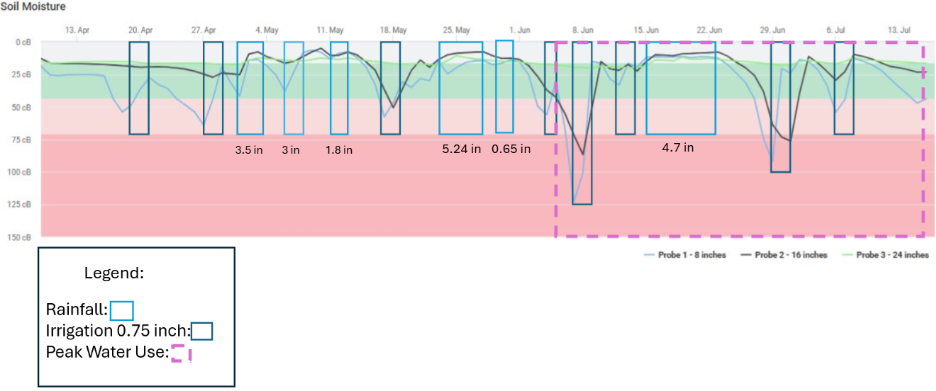
This second sensor graph shows the soil moisture readings in the trial from April 10th until July 16th. The overlayed boxes on the graph show irrigation events (0.75 in.) and significant rainfall events. Over the course of the growing season, a total of 20.93 inches of rainfall and 10.05 inches of irrigation have occurred in the field. The 5.24 inches of rain that occurred between May 22nd and May 27th happened before the crop reached its reproductive stages but was still within the late vegetative stages requiring more water. The crop entering the reproductive stage can be seen with the sharp increase in soil water tension shown at the beginning of June. During this time the crop was using upwards of 0.31 inches of water per day. The dashed purple box surrounding the latter half of the graph covers stages R1 to R5. As the beginning of the reproductive stages began, there was a large increase in soil water tension requiring irrigation during the time called peak water use. During this time the crop used upwards of 0.34 inches of water per day. Since then, only a few irrigation events have been triggered due to evening showers. Monitoring soil moisture is important during the last period of the dent stage. If soil moisture is favorable and the crop’s milk line has hit 75% or higher, terminating irrigation can be considered.
Final Thoughts
With this post coming out near the end of the season, you should be closely watching the progress of the milk line within your corn crop. Monitoring weather conditions, soil moisture, and the milk line on the ears is important at this stage of the crop. Irrigation should continue through the R5 stage and dent, and termination considerations should be made when the milk line is 75% or greater.
If weather conditions are not optimal for finishing up the crop’s water requirements to maturity, early irrigation termination can affect yield. Over application can negatively affect your profit, without yield benefits.
As always, if you have further questions about irrigation termination on corn, reach out to your local UGA County Extension Agent.